
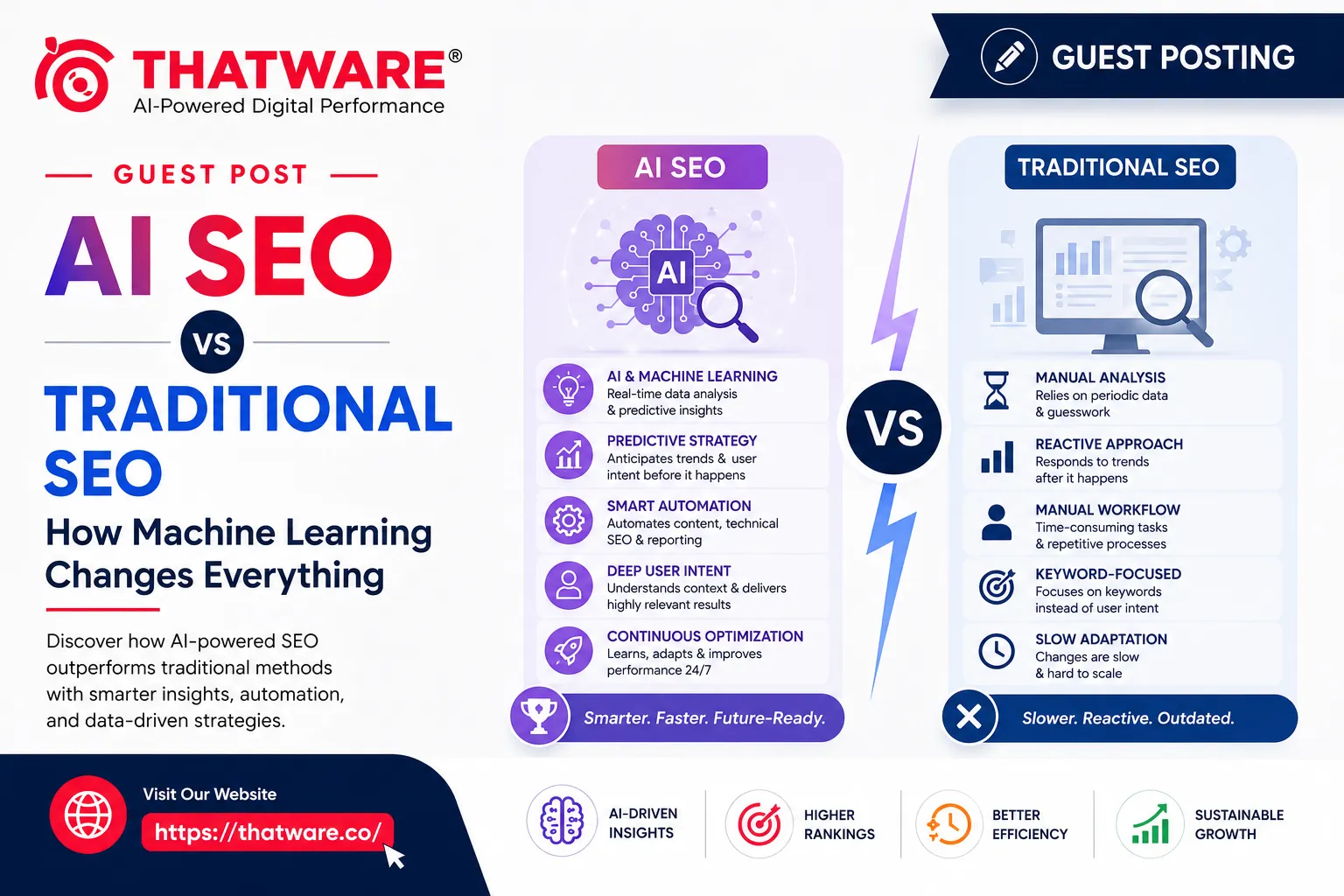
Let’s be honest about something: traditional SEO still works. Pages still rank from solid keyword research, clean technical structure, and authoritative backlinks. Anyone telling you the fundamentals are dead is selling something. But here’s the other truth — the ceiling on what traditional SEO can achieve has dropped considerably, while the complexity required to reach that ceiling has gone up. Machine learning didn’t replace SEO. It raised the bar.
Understanding why requires looking honestly at what each approach actually does, where each one breaks down, and what’s at stake when you choose between them.
What Traditional SEO Is Actually Doing
At its core, traditional SEO is pattern matching. You identify what signals Google appears to reward — certain keyword placements, a particular number of backlinks, a specific content structure — and you replicate those patterns across your site. It’s methodical, it’s teachable, and for a long time it worked because the pattern was relatively stable.
The process looks roughly like this: research keywords manually or with basic tools, audit your site for technical issues using a crawl report, build content around target terms, acquire backlinks through outreach, and monitor rankings monthly. Rinse, adjust, repeat.
The limitation isn’t that this is wrong. It’s that it’s slow, sequential, and human-scale. A skilled team can optimize maybe a few dozen pages a month. They can track a few hundred keywords. They can respond to algorithm changes weeks or months after they happen. All of that was fine when competition was lower and algorithms were simpler.
Where Machine Learning Enters the Picture
The AI SEO vs traditional SEO services debate often gets framed around speed — AI is faster, so it’s better. That’s an oversimplification that misses what’s actually different. Machine learning doesn’t just do traditional SEO faster. It does things traditional SEO literally cannot do.
Consider semantic analysis. A traditional keyword research process identifies terms with search volume and groups them loosely by topic. An ML-powered system maps the full semantic landscape around a topic — understanding entity relationships, intent variations, co-occurring concepts, and how Google’s knowledge graph connects all of it. The output isn’t just a keyword list. It’s a map of the topic space that tells you not just what to target, but how deep your coverage needs to be and what conceptual gaps your competitors aren’t filling.
Or consider behavioral signal analysis. Traditional SEO has no way to incorporate the click-through patterns, dwell time distributions, and query refinement behaviors happening across millions of searches related to your industry. Machine learning systems can surface patterns in this data that reveal how search intent is shifting — not what it was six months ago, but what it’s becoming right now.
The Technical Gap
Technical SEO is where the gap between approaches becomes most visible. A traditional technical audit produces a checklist: fix these crawl errors, improve these page speeds, add these structured data markups. The checklist is accurate. The problem is prioritization.
Not all technical issues have equal ranking impact. Some errors are cosmetic. Some speed improvements matter; others don’t show up in rankings at all. A traditional audit can’t tell you which is which without extensive manual testing. An AI-powered approach can model the likely ranking impact of each fix based on patterns across thousands of similar sites, prioritizing work by expected outcome rather than alphabetical order.
This is genuinely transformative for how development resources get allocated. Instead of spending a sprint fixing low-impact issues that were at the top of an automated list, teams address the two or three changes that will actually move rankings.
The Content Quality Difference
Traditional content SEO relies heavily on human judgment about what makes content good. Experienced writers produce well-researched, readable articles and hope they match what users want. The feedback loop is slow — you publish, wait weeks, check rankings, revise.
Artificial Intelligence SEO services compress and sharpen that loop dramatically. Content briefs are generated from live search data and semantic analysis rather than keyword spreadsheets. Performance signals feed back into content decisions continuously. And quality indicators — things like topical depth, entity coverage, reading level alignment with searcher sophistication — can be measured objectively against pages that are actually ranking.
This doesn’t mean AI writes better content. Human judgment, voice, and expertise still matter enormously — especially for EEAT signals. What it means is that the intelligence surrounding content production becomes much sharper. You’re writing for a clearly mapped intent, with awareness of what depth is required, guided by data on what formats and structures are performing in your specific competitive landscape.
Speed, Scale, and Compounding Returns
Traditional SEO is linear. You do more work, you get more results, roughly proportionally. AI-powered SEO creates compounding returns because each layer of optimization informs every other layer. Better semantic coverage improves the impact of new backlinks. Better technical performance amplifies the effect of content improvements. The system gets smarter over time as it accumulates data about what’s working for your specific domain.
For small sites in low-competition niches, traditional SEO is still often sufficient. But for any business operating in a competitive space, with a large site, or with significant organic growth ambitions — the calculus has shifted. The question isn’t whether to incorporate machine learning into your SEO strategy. It’s how quickly you can do it before competitors in your space do it first.
That’s not hype. That’s just where the field has moved.
